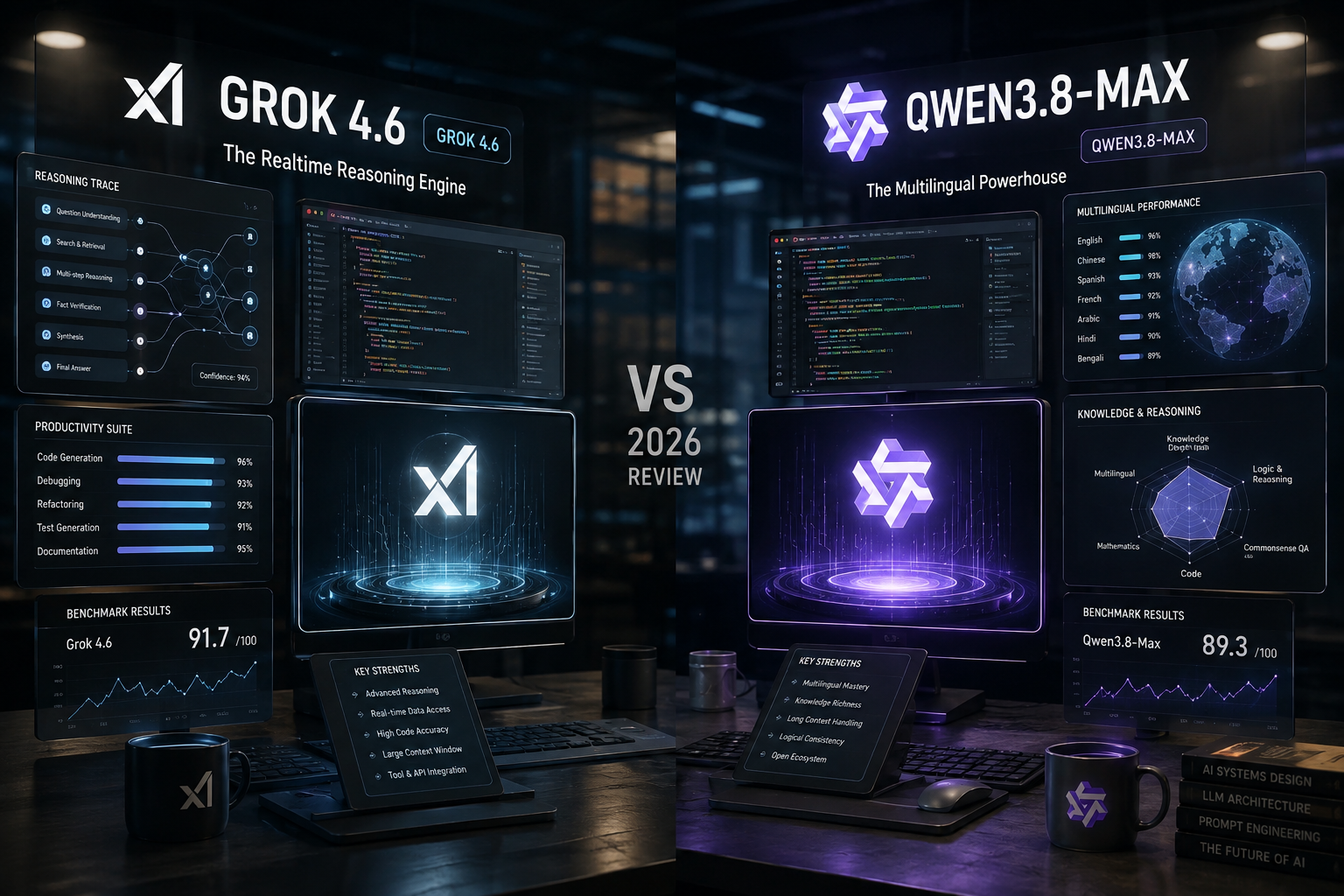
Choosing between Grok 4.6 and Qwen3.8-Max in 2026 requires more than comparing headline benchmark scores. Both models target demanding users who expect accurate answers, strong coding performance, complex reasoning, fast research, and dependable productivity assistance. However, they approach these goals from different directions, with distinct strengths in real-time information access, technical analysis, multilingual support, long-context work, and integration into daily workflows.
In this Grok 4.6 vs Qwen3.8-Max review, we compare the two systems across coding, reasoning, writing, research, mathematics, business productivity, context handling, speed, reliability, and overall value. We focus on the capabilities that matter in practical use rather than treating one impressive benchmark as a complete measure of quality. The better AI depends on the type of work we need to complete, the tools we use, the level of verification required, and whether we value live information or controlled, structured output most highly.
Grok 4.6 vs Qwen3.8-Max 2026 Review: Core Differences
The most important distinction between Grok 4.6 and Qwen3.8-Max is the experience each model is designed to provide. Grok 4.6 is generally positioned as a highly interactive assistant with strong conversational fluency, broad general knowledge, coding capability, and an emphasis on current events and live web-oriented research. It is particularly attractive when we need to examine rapidly changing information, discuss technology trends, analyze public conversations, or move quickly from an initial idea to a practical answer.
Qwen3.8-Max, by contrast, is better understood as a high-capability general-purpose model designed for structured reasoning, technical workloads, multilingual interaction, and extensive document processing. It is well suited to users who want carefully organized responses, detailed code analysis, mathematical problem solving, and controlled workflows. Its appeal is strongest in software development, data analysis, enterprise documentation, and tasks where consistency matters more than a highly informal conversational style.
Grok 4.6 can feel more spontaneous and direct, while Qwen3.8-Max often feels more methodical. We may prefer Grok when speed, current context, and conversational momentum are essential. We may prefer Qwen when a task requires a long chain of reasoning, strict formatting, source material analysis, or extensive technical decomposition.
Grok 4.6 vs Qwen3.8-Max for Coding and Software Development
For coding, both models can support professional development workflows, but the quality of the result depends heavily on the programming language, project complexity, available context, and how clearly we describe the expected behavior. Grok 4.6 is effective at generating application code, explaining unfamiliar libraries, converting code between languages, diagnosing common errors, and producing practical implementation suggestions. It is particularly useful during exploratory development, where we are moving rapidly between architecture questions, code snippets, debugging hypotheses, and documentation searches.
Grok 4.6 performs well when we provide a concise description of the problem and ask for a usable solution. It can help create API endpoints, frontend components, database queries, shell scripts, test cases, regular expressions, and configuration files. Its conversational style makes iterative debugging convenient because we can provide an error message, receive a proposed fix, report the result, and continue refining the implementation without restating the entire context.
Qwen3.8-Max has a stronger profile for deeply structured coding tasks. We can use it to review a repository design, trace dependencies across multiple modules, propose a migration plan, compare architectural patterns, and produce code that follows explicit project conventions. It is especially useful when we supply substantial source material and expect the model to preserve interfaces, naming standards, error-handling behavior, and testability.
Grok 4.6 vs Qwen3.8-Max for Debugging
Grok 4.6 is often convenient for fast debugging of isolated failures. Given a stack trace and a relevant code block, it can identify likely causes, suggest diagnostic commands, and explain what to inspect next. It also works well for runtime errors involving popular frameworks, cloud services, and frequently changing developer tools, particularly when current documentation or recent community discussion is relevant.
Qwen3.8-Max is more suitable when a defect is distributed across several layers. We can ask it to analyze an interaction between a frontend state update, an API response, a database transaction, and a background job, provided that we give it enough project context. Its structured reasoning makes it useful for distinguishing the immediate symptom from the underlying design problem. For production debugging, we should still validate every proposed fix with tests, logs, and reproducible cases.
Grok 4.6 vs Qwen3.8-Max for Code Quality
Qwen3.8-Max has an advantage when we ask for maintainable, production-oriented code rather than a quick prototype. It tends to be particularly valuable for identifying edge cases, documenting assumptions, adding validation, improving type safety, and designing test coverage. It can also review code against specific standards, such as secure input handling, separation of concerns, accessibility requirements, or performance constraints.
Grok 4.6 remains highly capable for code generation and review, especially when the project uses mainstream technologies. Its greatest advantage is workflow speed: we can move from question to implementation quickly and use the model as an interactive programming partner. For large codebases, however, the final result depends on how much repository context the model can inspect and whether the workflow provides reliable tools for searching, editing, testing, and validating files.
Grok 4.6 vs Qwen3.8-Max for Reasoning and Problem Solving
Complex reasoning is one of the most important categories in this comparison. Qwen3.8-Max is generally the stronger choice for tasks that require explicit decomposition, multi-step analysis, formal constraints, mathematical manipulation, or the comparison of several competing options. It is well suited to planning a system migration, analyzing a business process, interpreting a technical specification, or constructing a detailed decision framework.
For difficult prompts, Qwen3.8-Max can organize the answer into assumptions, constraints, intermediate conclusions, risks, and recommended actions. This structure reduces the chance that important details will be overlooked. It is also useful when we need the model to preserve a large set of requirements simultaneously, such as producing a database schema that satisfies normalization, performance, auditability, and access-control requirements.
Grok 4.6 is strong at practical reasoning and open-ended analysis. It can summarize a complicated subject, identify the main arguments in a debate, propose strategic options, and explain difficult concepts in accessible language. Its conversational flexibility is valuable when the problem is not fully defined at the beginning and we need to clarify the objective through several iterations.
Logical Reasoning and Mathematics
For formal mathematics, quantitative analysis, and logic-heavy exercises, Qwen3.8-Max is often the safer first choice. We can ask it to show assumptions, define variables, verify calculations, and explain alternative methods. This makes it useful for financial models, algorithm analysis, probability questions, optimization problems, and technical research preparation.
Grok 4.6 can also handle many mathematical and logical tasks, particularly when the problem is expressed clearly and the required calculations are moderate. It may be preferable when the task combines quantitative reasoning with current information, such as analyzing recent market data or comparing technology products based on changing specifications. In all cases, important calculations should be checked independently because fluent explanations can still contain arithmetic or assumption errors.
Grok 4.6 vs Qwen3.8-Max for Productivity and Daily Work
For general productivity, the choice is more balanced. Grok 4.6 is effective for rapid brainstorming, email drafting, meeting preparation, summarization, idea generation, and informal research. We can ask it to convert rough notes into a clear outline, create a list of questions for a business meeting, compare recent developments, or summarize a long discussion in a direct conversational style.
Qwen3.8-Max is particularly strong for repeatable productivity systems. We can use it to transform documents into structured data, extract action items, classify customer feedback, produce standard operating procedures, and create consistent reports. Its methodical output is useful when several people need to follow the same process or when the response must fit a predefined template.
For professional writing, both models can produce polished material, but their default styles differ. Grok 4.6 often creates energetic and accessible prose that works well for ideation, social content, technology commentary, and conversational explanations. Qwen3.8-Max tends to be better for formal documentation, technical reports, policy drafts, product requirements, and detailed business analysis where precision and organization are essential.
Grok 4.6 vs Qwen3.8-Max for Research and Current Information
Current information is a major factor in the Grok 4.6 vs Qwen3.8-Max decision. Grok 4.6 is especially valuable when we need to investigate recent events, emerging software releases, public discussions, technology announcements, or rapidly changing market developments. Its usefulness increases when the task depends on information that may have changed after the model’s original training period.
However, access to current information does not automatically guarantee accurate research. We should evaluate the quality of sources, distinguish primary documentation from commentary, check publication dates, and verify important claims. Grok 4.6 is best used as a fast research assistant that helps locate and synthesize information, while final decisions should rely on authoritative sources and direct evidence.
Qwen3.8-Max is often better for analyzing a fixed collection of documents. When we provide research papers, internal reports, contracts, product specifications, transcripts, or manuals, it can compare sections, identify inconsistencies, extract requirements, and produce a structured synthesis. This makes Qwen especially useful for document-heavy research workflows in which the source material is already available.
Grok 4.6 vs Qwen3.8-Max for Long Context and Document Analysis
Long-context performance matters when we work with large repositories, legal documents, technical manuals, research collections, or lengthy conversations. Qwen3.8-Max is a strong candidate for tasks requiring sustained attention across a substantial amount of input. We can use it to locate references, compare definitions, trace requirements, identify duplicated information, and summarize the relationship between distant sections of a document.
The quality of long-context analysis still depends on document structure. Clear headings, labeled sections, stable terminology, and focused questions make both models more reliable. We should also divide extremely large projects into logical units and ask for intermediate summaries rather than assuming that a single prompt will produce a perfect analysis of everything at once.
Grok 4.6 remains useful for document summarization and rapid extraction, especially when we need an executive overview or a quick explanation of the main points. It may be the more efficient option for shorter documents or when document analysis is only one step in a broader research conversation.
Grok 4.6 vs Qwen3.8-Max for Multilingual Performance
Qwen3.8-Max has a strong advantage for users who work across multiple languages or operate in international environments. It can assist with translation, multilingual documentation, localization review, cross-language code comments, and comparisons between regional terminology. It is particularly valuable when the goal is not merely literal translation but preservation of technical meaning, tone, formatting, and cultural context.
Grok 4.6 is also capable in many widely used languages and can produce natural translations and explanations. Its conversational style can be useful when we need to adapt content for a particular audience rather than translate it word for word. For high-stakes legal, medical, financial, or regulatory material, professional review remains necessary regardless of which model produces the initial draft.
Grok 4.6 vs Qwen3.8-Max: Accuracy, Hallucinations, and Reliability
Neither model should be treated as infallible. Accuracy depends on the prompt, available context, source quality, tool access, and task complexity. Both systems can generate plausible but incorrect statements, invent citations, misunderstand ambiguous requirements, or propose code that appears reasonable but fails under real execution.
Qwen3.8-Max is often preferable when we can provide source documents and define a strict output format. Grounding the answer in supplied evidence makes it easier to evaluate whether the model followed the material correctly. Grok 4.6 is highly useful for exploratory research and current topics, but we should be especially careful with claims derived from rapidly changing or disputed information.
The most reliable workflow combines model output with verification. We should request explicit assumptions, ask for citations where appropriate, run generated code, test calculations, compare answers from independent approaches, and inspect sensitive recommendations manually. For software development, automated tests, static analysis, type checking, and security scanning remain essential parts of the process.
Grok 4.6 vs Qwen3.8-Max: Speed, Style, and User Experience
Grok 4.6 generally feels fast and fluid during interactive conversations. Its concise, direct style can help us make decisions quickly, especially when we are asking follow-up questions or exploring several alternatives. It is a strong fit for users who prefer a natural dialogue and want the assistant to maintain momentum without excessive formal structure.
Qwen3.8-Max may be more suitable for users who value thoroughness and explicit organization. Its responses can be more detailed, with clearer separation between analysis, recommendations, implementation steps, and limitations. That additional structure may take longer to read, but it is valuable when the output will be converted into a plan, specification, report, or reusable business process.
The best choice therefore depends partly on working style. Grok 4.6 supports fast interactive exploration, while Qwen3.8-Max supports deliberate analysis and structured execution.
Grok 4.6 vs Qwen3.8-Max Pricing and Overall Value
Pricing and availability can change, so the strongest value depends on the plans, usage limits, API costs, and included tools available in our region. A lower subscription price is not automatically better if the model lacks the context window, integration, throughput, or reliability required for our workload. Conversely, a more expensive option may be justified when it reduces research time, accelerates development, or improves the quality of technical documentation.
For individual users, Grok 4.6 may deliver excellent value when the main needs are current research, coding assistance, brainstorming, and fast general-purpose interaction. For teams, Qwen3.8-Max may offer greater value when the priority is document analysis, multilingual work, structured output, technical reasoning, and repeatable automation.
We recommend evaluating both models with representative tasks rather than generic prompts. A practical test set should include a real bug, a long document, a complex reasoning problem, a multilingual request, a structured report, and a task involving current information. Measuring accuracy, correction time, output usability, and total effort gives a more meaningful result than relying on a single public ranking.
Grok 4.6 vs Qwen3.8-Max 2026 Review: Which AI Is Better?
The answer depends on the work we need to perform. Grok 4.6 is the better choice for current-information research, fast conversational assistance, rapid brainstorming, interactive coding, and technology-focused exploration. Its greatest strengths are speed, flexibility, live-context usefulness, and an engaging workflow that makes iterative questions easy.
Qwen3.8-Max is the better choice for structured reasoning, long documents, multilingual productivity, formal technical analysis, repository-level code review, and repeatable professional workflows. Its strengths are organization, depth, context management, and the ability to handle complex requirements without losing the overall structure of the task.
For developers and knowledge workers, using both models can be more effective than selecting one permanently. Grok 4.6 can accelerate discovery, provide current context, and generate fast working ideas. Qwen3.8-Max can then help analyze the details, refine the implementation, inspect edge cases, and convert rough material into a dependable final deliverable.
Overall, Grok 4.6 wins for speed and current conversational productivity, while Qwen3.8-Max wins for disciplined reasoning and document-intensive technical work. We should choose Grok 4.6 when immediacy and live information matter most, choose Qwen3.8-Max when precision and structured depth matter most, and validate both carefully when the outcome affects production software, business decisions, compliance, security, or financial results.