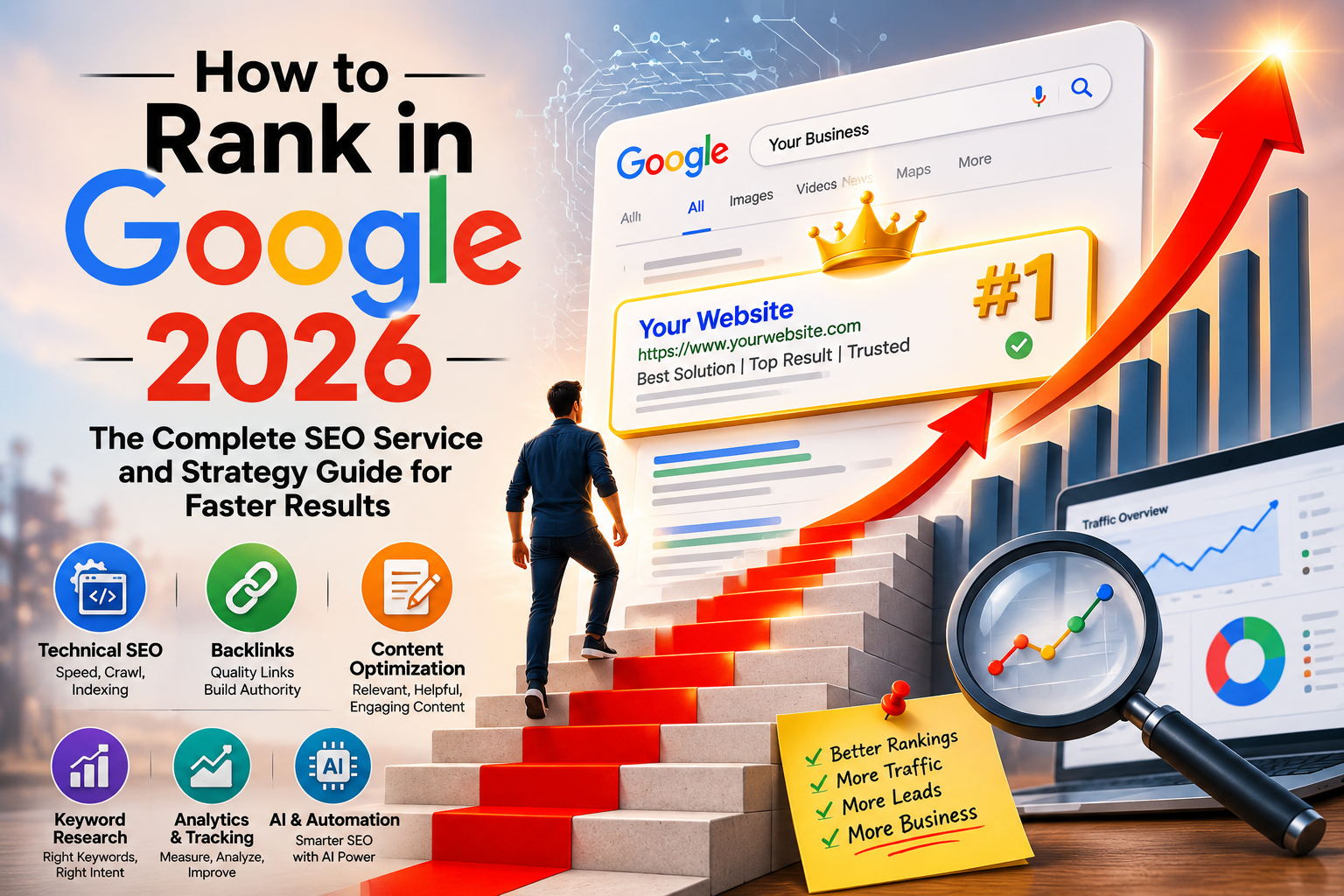
Ranking in Google in 2026 is less about discovering one secret optimization trick and more about building a website that consistently satisfies people, machines, and business goals. Search results have become a crowded marketplace where traditional organic listings compete with local packs, shopping results, videos, featured snippets, “People Also Ask” questions, news, forums, and AI-generated search experiences. That means a successful SEO strategy cannot focus only on placing a keyword in a title tag and waiting for traffic to arrive. You need a connected system that combines technical SEO, useful content, strong brand signals, credible references, excellent user experience, and reliable measurement.
The first shift to understand is that Google increasingly evaluates whether a page solves a real problem better than the alternatives. A page can be perfectly optimized at a basic technical level and still fail because it offers shallow information, repeats what every competitor has already said, or gives visitors no reason to trust the business behind it. Think of SEO as a restaurant review rather than a filing system: Google is not merely asking whether your page contains the right words; it is trying to determine whether the page deserves to be recommended. Your job is to make the answer obvious through quality, relevance, clarity, and evidence.
Current guidance from Google Search Central continues to emphasize helpful, reliable, people-first content, crawlability, page experience, structured data, and clear site organization. Search performance also changes quickly as competitors publish new material, consumer behavior evolves, and Google tests different result formats. For that reason, SEO should be treated as an operating process rather than a one-time project. The businesses that rank fastest usually combine focused technical improvements with pages aimed at high-value search intent, then monitor the results closely enough to make intelligent adjustments.
Build the SEO Foundations Before Chasing Rankings
Many companies begin SEO by ordering blog posts or buying backlinks, even though their websites have basic structural problems. Search engines may struggle to discover important pages, duplicate URLs may dilute signals, internal links may be weak, or slow templates may frustrate visitors before the content has a chance to persuade them. Fixing these problems does not guarantee a top position, but ignoring them creates friction everywhere else in your strategy. A strong SEO service begins with an audit that identifies what prevents Google from crawling, understanding, indexing, and confidently displaying the site.
Your foundation should include a clean domain setup, secure HTTPS, stable hosting, logical navigation, mobile-friendly layouts, descriptive URLs, accurate XML sitemaps, and a robots.txt file that does not accidentally block valuable resources. You should also verify the website in Google Search Console and review indexing reports, manual actions, page experience data, and performance queries. Search Console is especially useful because it shows how Google sees your pages in real search conditions, including impressions, clicks, average positions, and queries that may not appear in your original keyword research. Use those insights to find pages that are already close to success rather than assuming every improvement must start from zero.
Strengthen Technical SEO and Site Health
Technical SEO is the plumbing behind your website. Visitors rarely think about pipes when the water flows properly, and searchers do not care about your canonical tags when a page loads quickly and answers their question. Still, small technical failures can produce large commercial consequences. A site with thousands of broken links, conflicting canonical signals, inaccessible JavaScript content, or repeated low-value URLs can waste crawl resources and make it harder for search engines to identify the pages that matter most.
Run a technical audit that covers status codes, redirect chains, duplicate content, canonicalization, indexability, internal links, structured data errors, mobile rendering, image handling, JavaScript behavior, and Core Web Vitals. Pay particular attention to templates because a problem affecting one page type may affect every product, service, category, or article on the site. A single improvement to a shared template can create more value than dozens of isolated page edits. At the same time, do not treat audit tools as judges that automatically know what should be fixed first; prioritize problems according to traffic, conversions, crawl impact, and business importance.
Improve Crawling, Indexing, and Page Experience
Crawling and indexing are related but different. Crawling means Google discovers and fetches a URL, while indexing means Google decides whether that URL belongs in its searchable database and how it should be represented. A page can be crawlable but not indexed, indexed but poorly understood, or indexed successfully while still performing badly because it does not satisfy search intent. This is why simply submitting every URL through Search Console is not a sustainable ranking strategy.
Start by ensuring important pages are linked from other accessible pages and are not hidden behind unnecessary filters, login walls, or complex scripts. Use canonical tags carefully when similar URLs exist, but do not canonicalize genuinely different pages just to force them together. Improve page experience by reducing layout shifts, compressing large images, limiting excessive scripts, using dependable hosting, and making key content visible without intrusive interruptions. Speed matters, but usefulness matters too; a fast page that lacks the answer is still a poor result.
Create a Clear Website Architecture
A strong architecture helps both users and crawlers understand how your website fits together. Imagine your site as a well-organized library: the homepage is the entrance, major service or category pages are the main sections, and detailed articles are the books that answer specific questions. If everything is scattered randomly, visitors get lost and important pages receive little internal authority. If the structure is logical, each page supports the next stage of the customer journey.
Build navigation around the way your audience thinks, not the way your internal departments are arranged. Use descriptive anchor text such as “commercial roof repair services” instead of vague phrases like “learn more.” Connect informational content to relevant service, product, comparison, and contact pages so readers have a natural next step. Avoid creating hundreds of thin pages simply because a keyword tool suggests minor variations; a smaller number of comprehensive, differentiated pages often creates a stronger topical structure than a forest of near-duplicates.
Match Every Page to Search Intent
Keyword volume is useful, but intent is what determines whether traffic becomes business. A person searching “what is cloud accounting” may want a basic explanation, while someone searching “best cloud accounting software for small business” is comparing options and a searcher typing “cloud accounting consultant near me” may be ready to contact a provider. If you send all three audiences to the same generic page, you force one page to serve incompatible needs. That usually produces a weak experience and mediocre rankings.
Before creating or optimizing a page, identify the likely purpose behind the query. Look at the current results and ask what Google is rewarding: long guides, product pages, local businesses, videos, comparison tables, community discussions, or quick definitions. Study the common subtopics, page formats, freshness requirements, and levels of detail. Then create a page that meets the dominant intent while adding a meaningful advantage, such as original research, clearer explanations, useful tools, expert commentary, better examples, or a more convenient decision process.
Search intent can also change over time. A query that once produced mostly blog articles may later show product listings, calculators, videos, or local providers because user expectations have shifted. Review the search results periodically rather than treating intent as a permanent label. If your page ranks but receives few clicks, the title and snippet may not match the promise implied by the query. If it receives clicks but generates no engagement or conversions, the content may attract the wrong audience or fail to provide a relevant next step.
Build a Topic Map Around Customer Problems
A topic map connects the questions your audience asks before, during, and after a purchase. Instead of building a blog around disconnected keywords, organize content into clusters that reflect real customer journeys. A software company might cover problem awareness, implementation, integrations, pricing, comparisons, security, troubleshooting, and advanced use cases. A local service business might cover symptoms, urgency, costs, service areas, repair options, maintenance, and customer preparation.
Use a pillar page for a broad subject and supporting pages for narrower questions, then connect them with purposeful internal links. This structure helps readers move from education to evaluation and eventually to action. It also gives your team a practical way to identify gaps: if you have a page about a service but nothing explaining costs, alternatives, timelines, risks, or selection criteria, the topic cluster is incomplete. A topic map should serve the audience first and search engines second; otherwise, it becomes a keyword diagram with no commercial or editorial logic.
Publish Content That Deserves to Rank
Content quality in 2026 is not measured by word count alone. A 700-word page can outperform a 3,000-word article when it answers the question directly, includes the right evidence, and avoids unnecessary detours. On the other hand, a complex topic may require depth because readers need context, examples, calculations, objections, and practical steps before they can make a decision. The right length is the length required to resolve the searcher’s problem completely and efficiently.
Start every important page with a clear promise. Tell readers what they will learn, decide, compare, or accomplish, then deliver that value early instead of burying it under a long introduction. Use original examples, screenshots, diagrams, customer scenarios, expert interviews, data, and transparent explanations of limitations. If you are writing about financial, medical, legal, safety, or technical matters, strengthen the page with qualified review and clearly presented sources. Trust is not a decorative element; it is the bridge between information and action.
AI-assisted writing can speed up research and drafting, but mass-producing generic pages creates a serious quality problem. Search engines do not need another article that rearranges existing summaries without adding insight. Use automation for outlining, content briefs, data processing, and editorial assistance, while keeping human judgment responsible for accuracy, experience, examples, tone, and final recommendations. Ask a simple question before publishing: if the brand name and formatting disappeared, would this page still offer something genuinely useful that a reader could not easily get from ten competing pages?
Demonstrate First-Hand Experience and Expertise
First-hand experience is one of the strongest ways to separate useful content from generic content. If you review a product, explain how it was tested, what conditions affected the result, and where the product performed poorly. If you publish a business guide, include observations from real projects, implementation lessons, customer questions, or mistakes that changed your process. Readers recognize the difference between advice that has been lived and advice assembled from surface-level research.
Expertise should also be visible rather than implied. Add author bios that explain relevant qualifications, editorial policies that show how information is checked, and citations where claims depend on external evidence. Businesses can publish case studies, before-and-after examples, client outcomes, process photographs, and transparent pricing explanations. These elements create a stronger trust signal for people and can make your content more distinctive in search results that are increasingly filled with interchangeable summaries.
Refresh Content Without Destroying Its Search Value
Content refreshing is not the same as changing the publication date. A meaningful update reviews the page against current search results, user questions, product changes, regulations, statistics, screenshots, links, and competitor improvements. Preserve sections that already attract valuable traffic unless they are inaccurate or redundant, and expand areas where users appear to need more help. Check Search Console for queries that generate impressions but are not addressed clearly; these often reveal easy opportunities to improve relevance.
Refresh strategically rather than rewriting every article on a calendar. Prioritize pages with declining clicks, strong rankings just outside the top results, high conversion potential, outdated information, or valuable backlinks. Record what changed and monitor performance afterward so you can learn which improvements actually worked. A page that loses visibility after an update may need its original focus restored, its intent alignment corrected, or its internal links rebuilt.
Optimize On-Page SEO for Humans and Search Engines
On-page SEO begins with making the subject of a page unmistakable. Create a concise, specific title that reflects the primary intent without awkward keyword repetition. Write a meta description that explains the benefit of clicking, although Google may generate a different snippet when it believes another passage better matches the query. Use one clear H1, descriptive subheadings, readable paragraphs, meaningful image alt text, and natural language that includes important concepts without sounding mechanical.
The opening section deserves special attention because it confirms whether the visitor made the right click. State the problem, define the scope, and show the reader what the page will help them do. Place important qualifications near the claims they qualify instead of hiding them at the bottom. Add comparison tables, checklists, formulas, examples, and step-by-step instructions when they genuinely make the topic easier to understand, but do not turn every page into a collection of visual fragments that interrupts the reading experience.
Internal links should guide users toward the next logical question. Link from broad pages to detailed resources, from informational pages to relevant commercial pages, and from older content to newly updated resources. Avoid using the same exact anchor text everywhere because natural language gives better context and feels less manipulative. Image filenames, headings, URLs, and surrounding text should reinforce the topic, but the page should still read naturally when those SEO elements are ignored.
Use Structured Data and Search-Friendly Formatting
Structured data helps search engines interpret information such as products, reviews, events, recipes, organizations, local businesses, courses, and articles. It does not guarantee rich results or higher rankings, and markup must accurately represent visible page content. Use the schema types supported for your situation, validate the implementation, and remove markup that is misleading, incomplete, or no longer relevant. Think of structured data as a label on a package: it improves identification, but it cannot compensate for a poor product inside.
Formatting also affects how easily a page can be understood and extracted. Define terms before using complex language, answer common questions directly, and place important facts in complete sentences rather than relying solely on decorative design elements. Use tables for genuine comparisons and lists for actual sequences or grouped items. This approach helps readers scan while preserving the context that search systems need to interpret your claims accurately.
Build Authority Through Digital PR and Relevant Links
Backlinks remain useful because independent references can reinforce a site’s credibility, but the quality and context of those links matter more than raw volume. A link from a respected industry publication, local organization, university resource, professional association, or relevant business can send stronger trust signals than dozens of unrelated directory links. Authority is also built through brand mentions, expert participation, original research, reviews, partnerships, and consistent evidence that your organization is known for a particular subject.
Digital PR works best when you have something worth discussing. Conduct a survey, publish a useful dataset, create an industry benchmark, analyze public information, develop a free calculator, or provide expert commentary on a developing issue. Then pitch the insight to journalists, editors, podcast hosts, newsletters, and community publishers who already cover the topic. The objective is not to persuade anyone to insert an artificial link; it is to make your expertise visible in places where your audience already pays attention.
Earn Backlinks Without Creating Risk
Avoid link schemes, automated placements, private networks, irrelevant guest-post campaigns, and packages that promise a specific number of links at an unusually low price. These tactics may produce a temporary spike in referring domains while creating long-term cleanup work and reputational risk. A professional SEO service should explain where links will come from, why those sources are relevant, what editorial standards apply, and how success will be evaluated beyond a spreadsheet of URLs.
Create linkable assets that solve a real problem for publishers and readers. Original statistics, interactive tools, visual explainers, expert roundups with genuine contributions, detailed case studies, and local resource pages can all attract references when promoted properly. Reclaim unlinked brand mentions, repair broken links pointing to missing pages, and contact sites that cite outdated resources with a better replacement. Link building is closer to relationship building than button pressing; relevance, patience, and credibility compound over time.
Adapt SEO for Local Businesses and Ecommerce
Local SEO depends on relevance, distance, prominence, and the quality of your business information across the web. Complete and accurate Google Business Profile details are essential, including category selection, services, hours, photos, service areas, and review responses. Build location pages that provide genuinely local information rather than swapping city names into identical templates. Mention neighborhoods, landmarks, regulations, customer situations, service limitations, and local proof where appropriate.
Reviews deserve a process, not occasional attention. Ask satisfied customers for honest feedback at an appropriate point, make the request easy, and respond professionally to positive and negative comments. Never create fake reviews or offer misleading incentives. Local authority can also grow through chambers of commerce, community organizations, local news, sponsorships, suppliers, and partnerships that produce legitimate citations or mentions.
Ecommerce SEO requires a different balance between discovery and conversion. Optimize category pages for broader commercial intent and product pages for specific purchase intent, while preventing filters and parameter combinations from creating index bloat. Use accurate product names, specifications, availability, pricing, shipping information, return policies, original photography, and customer questions. If a product is unavailable, provide helpful alternatives or a waitlist instead of leaving visitors on a dead-end page that signals poor maintenance.
Prepare for AI Search and Multimodal Discovery
AI search experiences change how people discover information, but they do not eliminate the need for strong SEO foundations. Systems that generate answers still need accessible, understandable, trustworthy information from websites and other sources. Clear definitions, direct answers, supporting evidence, unique examples, consistent business details, and strong topical coverage make your content easier to interpret and reference. You should optimize for being the best source, not merely for being quoted in a particular interface that may change next month.
Write in a way that supports both quick extraction and deep reading. Use descriptive headings, concise answers followed by context, structured comparisons, original data, and clear attribution. Cover related entities and concepts naturally so the page demonstrates subject understanding without stuffing keywords. Build brand recognition beyond your website through expert profiles, reputable mentions, reviews, videos, community discussions, and useful contributions that confirm your organization exists and knows its field.
Multimodal discovery also means your strategy should not stop at text. Product imagery, demonstrations, instructional videos, podcasts, diagrams, downloadable tools, and visual explainers can reach people through different search surfaces. Ensure media has descriptive titles, transcripts or captions where relevant, accessible presentation, and a clear connection to the core page. The future of search is not one blue-link list; it is an ecosystem of answers, experiences, and actions.
Measure SEO Performance and Connect It to Revenue
Rankings are useful diagnostic signals, but they are not the final business outcome. A page ranking in position three for a low-value query may be less important than a page ranking in position twelve for a high-conversion commercial term. Track organic clicks, impressions, qualified traffic, engagement, leads, sales, revenue, assisted conversions, phone calls, form quality, and customer acquisition cost. Segment results by page type, topic, device, location, brand versus non-brand queries, and new versus returning visitors.
Use Google Search Console for query and page visibility, analytics software for user behavior and conversions, and a rank-tracking platform for consistent monitoring across priority terms. Connect lead forms and phone calls to the pages and campaigns that influenced them whenever possible. If your sales cycle is long, import offline conversion data or at least record lead quality so SEO is not judged only by immediate online actions. Measurement should answer practical questions: Which pages create demand? Which queries attract buyers? Where do visitors abandon the journey? What should receive resources next?
Set realistic expectations about timing. Technical corrections can sometimes produce quick improvements, while competitive topics, new domains, and authority-building campaigns often require sustained effort. Report progress in layers: visibility first, qualified traffic next, and revenue impact after the conversion path has enough data. This prevents the common mistake of celebrating impressions that never become meaningful business opportunities.
Follow a Practical 90-Day SEO Roadmap
A focused 90-day plan creates momentum without pretending that every SEO problem can be solved at once. During the first month, establish measurement, crawl the site, identify indexation issues, review competitors, map high-value search intent, and prioritize technical fixes. Repair broken templates, improve critical pages, remove accidental barriers, and document the baseline. At the same time, interview customers or sales staff because real language from buyers often reveals content opportunities that keyword tools miss.
During the second month, optimize the pages closest to commercial value. Improve titles, introductions, headings, internal links, calls to action, proof elements, media, and conversion paths. Create briefs for new pages based on gaps in the current search results rather than producing content simply to meet a publishing quota. Begin one or two authority campaigns built around original insights, partnerships, expert contributions, or genuinely useful resources.
During the third month, publish priority content, promote linkable assets, improve local or product visibility, and analyze early performance. Compare pages that improved with pages that did not, then look for patterns involving intent, depth, internal linking, page experience, and authority. Revisit the roadmap using evidence rather than assumptions. A practical recurring workflow might include a monthly technical review, weekly Search Console analysis, regular content updates, quarterly competitor research, and continuous conversion testing.
The fastest results usually come from prioritization. Do not spend three weeks adjusting image filenames while a high-value service page has no internal links and an unclear offer. Do not publish fifty articles when ten strategic pages could cover the customer journey properly. Rank tasks using a simple formula that considers expected impact, confidence, effort, and business value. SEO becomes much more effective when every recommendation has an owner, a deadline, a measurement method, and a reason connected to customer or company outcomes.
Conclusion
Ranking in Google in 2026 requires a complete SEO strategy rather than a collection of isolated tricks. Build a technically accessible website, organize it around real customer problems, match each page to search intent, publish material with first-hand value, strengthen trust, earn relevant authority, and measure outcomes that matter to the business. AI-generated search experiences and changing result formats make visibility more complex, but the underlying principle remains straightforward: become the clearest, most useful, and most credible answer for the people you want to reach.
A professional SEO service should give you more than reports filled with percentages. It should provide prioritization, technical expertise, editorial judgment, ethical authority building, conversion insight, and a repeatable process for learning from results. Start with the pages and problems closest to revenue, remove the obstacles that prevent search engines and users from understanding your value, and improve consistently. SEO is not a slot machine where one clever trick produces instant winnings; it is an asset that grows when every part of the system supports the others.
What is the fastest way to improve Google rankings in 2026?
The fastest legitimate gains usually come from fixing serious technical issues, improving pages that already rank on the second page, aligning content with search intent, strengthening internal links, and improving titles and snippets. These actions can produce faster movement than publishing large volumes of new content because they build on existing visibility and relevance.
How long does SEO take to show results?
Some technical or on-page improvements may show movement within weeks, while competitive keywords and authority-building campaigns often take several months. The timeline depends on competition, site history, content quality, technical health, brand authority, and how consistently the strategy is executed. Measure progress through visibility, qualified traffic, leads, and revenue rather than rankings alone.
Does AI-generated content rank on Google?
Content created with AI can rank when it is accurate, useful, original, well-edited, and genuinely satisfies the searcher. The risk comes from publishing large amounts of generic, repetitive, inaccurate, or unhelpful material without human oversight. Use AI to support research and production, but add real expertise, first-hand experience, editorial review, and distinctive value.
Are backlinks still important for SEO in 2026?
Relevant, trustworthy links can still support authority and discovery, but quantity alone is a poor strategy. Earn links through original research, digital PR, valuable tools, partnerships, expert contributions, and resources that publishers genuinely want to reference. Avoid manipulative link schemes and low-quality packages that create risk without meaningful relevance.